

As we navigate the complexities of 2025, global markets remain fraught with uncertainty, from geopolitical tensions and supply chain disruptions to rapid shifts in consumer behaviour and economic policies. For executives, the ability to forecast accurately becomes a survival imperative.
Welcome to the AI-powered predictive analytics. A game-changing fusion of machine learning, big data, and real-time insights that empowers leaders to anticipate disruptions and seize opportunities in these volatile times.
In this edition of The AI Executive, I’ll explore how this technology is reshaping strategic decision-making, by drawing on recent advancements and real-world applications to provide actionable insights for C-suite leaders.
Understanding AI-Powered Predictive Analytics

At its core, predictive analytics uses historical data, statistical algorithms, and machine learning to forecast future outcomes. However, when it is supercharged by AI, and particularly generative models and large language models (LLMs), it then evolves from static projections to a dynamic, adaptive forecasting superpower. These types of systems ingest vast datasets, including real-time market signals, social media sentiment, and even decentralized prediction markets, to generate probabilistic scenarios with unprecedented precision.
For instance, AI-driven tools now integrate external factors like weather patterns for commodity trading or geopolitical events for financial hedging, allowing for continuous refinement of predictions. Unlike the traditional methods that are reliant on spreadsheets and periodic reports, the use of AI enables “continuous planning,” where forecasts update in real-time to mitigate economic volatility.
The Transformation in Executive Forecasting
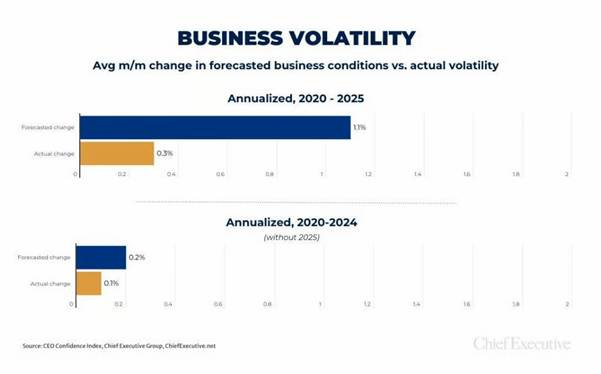
As we know, in volatile markets, traditional forecasting often falls short, with errors that are usually amplified by unforeseen events. AI addresses this issue by enhancing accuracy. Some organizations that are already adopting these tools, have reported improvements of up to 50% in forecasting precision, which enables faster responses to market shifts. This is particularly evident in sectors like retail and finance, where AI processes real-time data to anticipate demand fluctuations and optimize inventory.
Consider retail demand forecasting for example. AI leverages machine learning to analyse sales data, consumer trends, and external variables. The results of this learning process is that the AI will produce highly accurate predictions that reduce stockouts and overstock by integrating big data and real-time insights.
Another example is the commodity markets. Similarly, AI’s continuous learning from new data provides short- and long-term forecasts, helps businesses preempt price changes amid supply chain volatility.
A notable 2025 development is the integration of prediction markets into mainstream platforms. Google Finance now incorporates data from decentralized sources like Kalshi and Polymarket, using AI to analyse real-time sentiment and probabilities for enhanced risk assessment and decision-making. This “decentralized intelligence” aggregates diverse perspectives, refining price discovery and minimizing arbitrage in uncertain environments.
For executives, this means shifting from reactive strategies to proactive ones. For example, in strategic inventory planning, AI simulates scenarios to balance supply and demand in volatile conditions, transforming potential risks into opportunities. Similarly, in finance, generative AI automates executive summaries, performance metrics, and dashboards from raw ERP data, delivering insights in minutes rather than days.
Key Benefits for Business Leaders
The strategic value of AI-powered predictive analytics extends beyond accuracy to holistic business resilience:
Enhanced Decision-Making: Real-time AI insights turn data into actionable intelligence, supporting pricing, FX hedging, and portfolio rebalancing in dynamic markets. Executives can now use AI as a “decision companion,” simulating outcomes to sharpen choices amid volatility.
Operational Efficiency: In demand forecasting, AI automates planning and optimizes supply chains, reducing waste and improving agility, critical in 2025’s fast-paced landscape.
Risk Mitigation: By quantifying market sentiments and potential disruptions, AI enables dynamic hedging and sentiment analysis, providing a competitive edge in event-driven trading.
According to McKinsey’s 2025 Global Survey on AI, high-performing organizations are capturing real value by aligning these technologies with core strategies, potentially unlocking trillions in annual economic impact across industries.
Challenges and Strategic Considerations
While transformative, implementation isn’t without hurdles. McKinsey identifies key risks, such as lacking a clear executive vision, undefined value from use cases, or ignoring ethical implications, which can derail AI programs. Executives must invest in talent, like analytics translators, and build purpose-built platforms to scale effectively.
Data quality remains paramount; AI thrives on clean, diverse inputs, so integrating external sources without bias is essential. Moreover, in regulated sectors, ensuring compliance with evolving AI safety standards is critical to avoid pitfalls.
Looking Ahead: A Call to Action
As 2025 unfolds, AI-powered predictive analytics will only grow in sophistication, incorporating advancements like AI agents for automated portfolio adjustments and deeper integration with blockchain for secure, decentralized forecasting. For executives, the message is clear: embrace this technology and turn volatility into an advantage.
Start by assessing your organization’s forecasting maturity, pilot AI tools in high-impact areas like demand planning or financial modelling. Collaborate with experts to align AI with your strategic goals, and monitor emerging trends like prediction market integrations.
In an era where foresight defines success, AI becomes your executive edge. Stay tuned to The AI Executive for more insights on harnessing AI for strategic leadership.
Regarding this, how will AI address bias? Very insightful.