


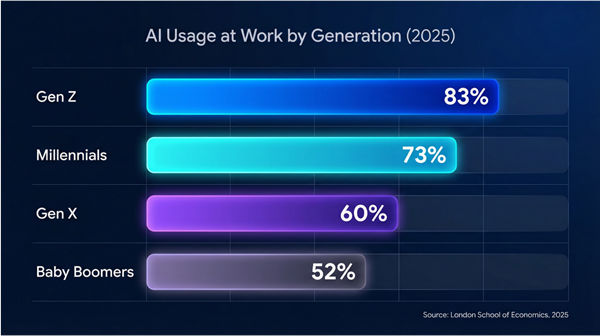
A 31-point gap in AI adoption separates Gen Z from Baby Boomers. This is a critical vulnerability that threatens to undermine the multi-trillion-dollar AI revolution.
The New Generation Gap is in the Cloud
A quiet but profound transformation is reshaping the modern workplace and it is about who truly understands and wields the most powerful business tool of our time: Artificial Intelligence. The data reveals a startling new generation gap. According to a 2025 study from the London School of Economics, a staggering 83% of Gen Z employees now use AI at work, a figure that plummets to just 52% for Baby Boomers.
This is a fundamental divergence in cognitive approach. As OpenAI CEO Sam Altman observed, older generations tend to use AI as a mere “Google replacement,” a tool for simple information retrieval. In stark contrast, younger employees are using it as a foundational “operating system” for their work and life, weaving it into complex workflows and connecting it to multiple data sources. The gap is not just in usage, but in imagination.
The Dangerous Blind Spot in the C-Suite
While digital natives are integrating AI into the very fabric of their professional lives, a dangerous blind spot persists in the C-suite. The numbers are damning: less than 6% of CEOs at the world’s largest companies have ever worked in the tech sector, and a 2024 study found that a mere 8% of senior executives possess a substantial conceptual knowledge of AI.
This creates a perilous situation where leaders are placing massive, career-defining bets on a technology they do not fundamentally understand. They are delegating AI strategy, becoming, as one expert notes, unqualified to steward the immense capital being poured into these initiatives. Boston Consulting Group calls this the “electricity moment.” When electricity was introduced, the real revolution wasn’t replacing gas lamps with light bulbs; it was redesigning the entire factory around electric machines. Today, most companies are stuck in the light-bulb phase, focused on incremental automation because their leaders can’t envision the new factory.
“They should be redesigning the factory, but they can’t redesign what they don’t understand.”
When Empathy Isn’t Enough: The Hollow Promise
The consequences of this fluency gap are already rippling through organizations. A recent study found that nearly half of Gen Z employees now turn to AI for work-related advice instead of their own managers. This is a vote of no confidence. It signals a breakdown in communication and trust between leaders and their teams.
Many well-intentioned executives are attempting to quell workforce anxiety about AI with reassuring town halls and internal memos. But these efforts often fall flat. As one Salesforce report bluntly states, empathy without technical fluency rings hollow. You cannot authentically address fears about a technology you do not truly comprehend.
“When a CEO says, ‘We’ll figure this out together,’ but doesn’t understand how AI agents work... that empathy rings hollow. Workers see right through it.”
The Path Forward: From Luddite to Leader
Closing this dangerous fluency gap requires a radical new approach to leadership development. The traditional top-down model is obsolete. The most direct path to AI literacy for today’s executives is through reverse mentoring. Organizations must create structured programs where junior employees, the true digital natives, are empowered to teach senior leaders. This is no longer a nice-to-have; it is a strategic imperative.
The goal is not for every CEO to become a coder, but for every leader to become a “Chief AI Orchestrator”. This means developing enough fluency to ask the right questions, challenge assumptions, and distinguish genuine innovation from the smoke and mirrors of vendor hype. It requires leaders to publicly embrace their own learning journey, sharing their mistakes and modelling the intellectual curiosity that the AI era demands.
Your Legacy Depends on Your Literacy
The AI fluency crisis is not a problem that can be delegated or outsourced. It is a direct and urgent challenge to the authority, credibility, and long-term effectiveness of every executive. The 31-point chasm between your most experienced leaders and your youngest employees is a measure of your organization’s vulnerability. Closing this gap is no longer optional; it is the defining leadership test of our time. Your legacy will be determined not by the size of your AI budget, but by the depth of your AI understanding.
Couldn't agree more. This distinction between AI as an operating system versus a Google replacment is a foundational insight. Thank you for articulating it so clearly.
Great article thank you for sharing. Is it possible to share the sources for this data including parts around, "The numbers are damning:" and " A recent study found that nearly half of Gen Z employees now turn to AI for work-related advice instead of their own managers. "
Thank you kindly