

Executive Summary
This first week of December, was marked by significant advancements in reasoning capabilities and physical world interactions. Such advancements were highlighted by NeurIPS 2025’s emphasis on refinement loops that enable adaptive, human-like problem-solving in models.
We also had key releases included xAI’s new model for enhancing robotics and autonomous systems by improving towards a better physical understanding. At the same time OpenAI and Anthropic bolster security and efficiency in large language models.
These developments signal a strategic shift toward practical AI deployment in industries like healthcare and manufacturing, with implications for accelerating automation while addressing infrastructure bottlenecks like the global memory chip crunch.
Strategic Analysis
This week’s standout development was the NeurIPS 2025 conference, which underscored a paradigm shift in AI progress from pure scaling to refinement loops. That is systems that iteratively explore, verify, and improve outputs, leading to “jagged intelligence”, where models excel in verifiable tasks like math and coding but falter elsewhere without strong feedback signals.
The business impact is that this improvement enables cost-effective automation in knowledge-intensive sectors with the potential to reduce R&D cycles by 30-50% in pharmaceuticals and software development. However, it also exposes risks in domains lacking clear verifiers, such as creative marketing or ethical decision-making, where AI could amplify biases or errors.
Implementation framework: Adopt a “Refinement Readiness Assessment” by:
(1) mapping tasks to knowledge coverage and verifiability scores,
(2) piloting small-scale loops with tools like OpenAI’s o-series for reasoning tokens, and
(3) scaling via hybrid human-AI oversight to mitigate gaps, targeting a 20% efficiency gain in the first quarter.
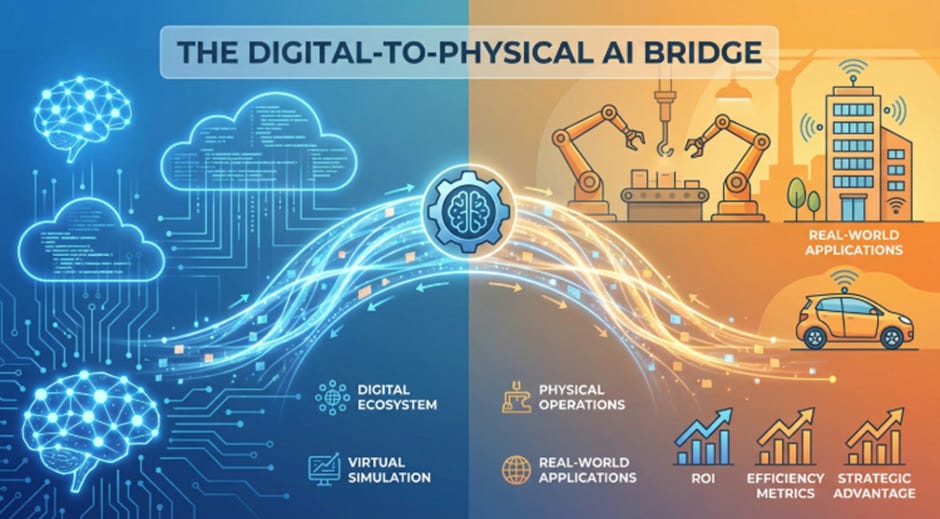
The second major highlight of the past week was xAI’s launch of a model focused on physical world interactions, promising breakthroughs in robotics by improving manipulation and environmental understanding.
The business impact of this development will be felt in manufacturing and logistics, where it could cut operational costs by 15-25% through smarter autonomous systems. Of course, it heightens competition for hardware resources amid the AI-driven memory chip shortage.
Implementation framework: Use a “Physical AI Integration Roadmap” involving:
(1) auditing current robotics for compatibility,
(2) prototyping with xAI’s API in controlled environments like warehouse simulations, and
(3) measuring ROI via metrics like error reduction and throughput, with phased rollout to full production over 6-12 months.
Action Items
Evaluate your organization’s tasks for refinement loop potential by conducting a one-week audit using free tools like Google DeepMind’s open resources. Prioritize verifiable domains like data analysis for immediate AI augmentation.
Pilot xAI’s physical interaction model in a non-critical process, such as inventory management. Integrate it with existing robotics platforms and track performance metrics against baselines.
Address infrastructure risks by partnering with suppliers like NVIDIA for AI-optimized hardware, securing contracts to mitigate the memory crunch, and budgeting for a 10-20% increase in compute costs next quarter.
Upskill executive teams through targeted workshops on AI safety and reasoning, leveraging Anthropic’s latest updates to simulate real-world scenarios and foster ethical deployment.
Executive Insight
The rapid growth of AI Technology announced during last week’s NeurIPS Conference provides validation for the potential of AI as a transformative tool by demonstrating its ability to replicate human-type adaptive behaviours on an unprecedented scale. However, it is critical that any organisations that leverage AI technology continue to conduct thorough validation and testing, since excessive dependence on these automated business processes could lead to misinformation and unintended consequences due to over-reliance on uneven intelligence..
The introduction of this week’s models for building three-dimensional (3D) environments in the physical world is a major advancement toward bridging the gap between human-like cognitive ability found within digital AI Technology and real-world behaviours, similar to how organisations process real-time data to generate valuable insights about their operations.
Organisational leaders should embrace the models of the physical world as a springboard to explore more experimental approaches, by introducing AI Technology into their business processes and embrace the use of AI Technology in their organisations as a vehicles through which to amplify their strategic advantages over