

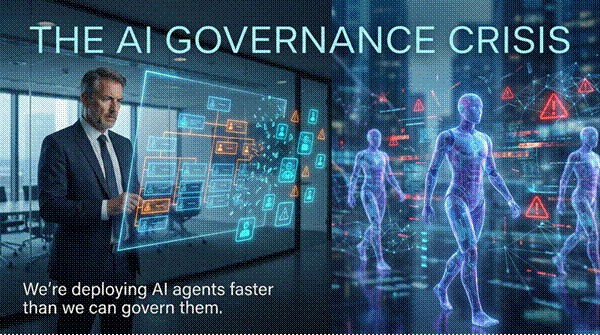
While agentic AI adoption is set to triple in two years, only 20% of companies have the governance structures to manage it. This is an organizational time bomb.
The Illusion of Progress
Enterprise leaders are in a frantic race to deploy agentic AI. The numbers are staggering: Deloitte projects that usage will surge from 23% to 74% in just two years. Yet, beneath this veneer of rapid adoption lies a dangerous reality. A stunning 84% of these same organizations have not redesigned their roles or structures to accommodate these new autonomous systems. This is the central paradox of enterprise AI in 2026: the capability curve has catastrophically outpaced the organizational readiness curve.
Companies are treating agentic AI as a simple procurement, a tool to be layered onto existing workflows. The result is what experts are calling “workslop”: poorly designed agentic tools that add complexity and increase operational workload rather than reducing it. By attempting to automate processes originally designed for humans, leaders are creating a new layer of digital bureaucracy, all while believing they are innovating.
The Pyramid is Dead. Your Org Chart is Next.
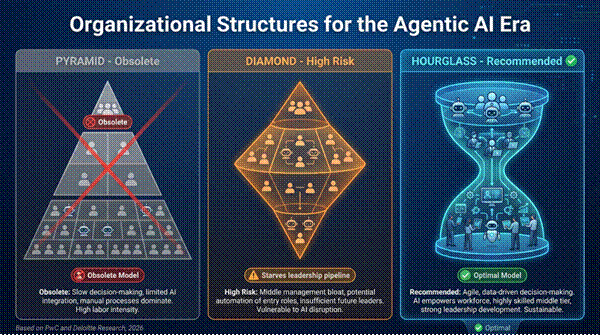
The traditional corporate structure, a pyramid with a wide base of entry-level workers, is obsolete. As AI agents absorb routine tasks, many companies are defaulting to a diamond-shaped structure, shrinking their entry-level pipeline and expanding the middle layer to manage the new silicon workforce. According to PwC, this is a perilous long-term risk. By cutting off the apprenticeship pipeline, you starve your organization of its future leaders and the deep, process-specific expertise needed to correct AI errors and spot systemic risks.
Instead, forward-thinking firms are adopting an hourglass model. This structure maintains a strong, AI-literate entry-level base, a lean and highly skilled middle layer focused on exception handling and coaching, and a forward-looking leadership team. This deliberate structural choice preserves the talent pipeline while leveraging AI for what it does best.
The Real Bottleneck is Governance
The failure to scale agentic AI is not a technological one. Gartner predicts that over 40% of agentic AI initiatives will fail by 2027 simply because they cannot integrate with legacy systems. The real bottlenecks are structural and procedural.
First, most enterprise systems were not built for real-time, autonomous agents. They rely on slow, batch-based data processes (ETL) that are fundamentally incompatible with agents needing fresh data for fast decisions.
Second, true value emerges when specialized agents operate collectively, like a microservices model. Yet most companies lack the secure, trustworthy protocols (like MCP or A2A) for agents to interoperate at scale.
Third, in a world of token-based pricing, every action an autonomous agent takes has a cost. Without a robust FinOps for AI framework, companies are giving autonomous agents a blank check, leading to uncontrolled and unpredictable expenses.
The Path Forard: Building a Silicon Workforce
Treating AI agents as a new category of labor, a “silicon-based workforce”, is the critical mental model shift required. This is not about replacing humans, but augmenting them and redesigning the very nature of work. Moderna has already taken the radical step of merging its technology and HR functions under a single Chief People and Digital Technology Officer to formally integrate its human and silicon talent.
To navigate this transformation, executives must become architects of a new operating model.
First, choose your organizational structure deliberately. Do not default to the diamond. Analyze your need for an apprenticeship pipeline and make a conscious choice between the diamond and hourglass models. Your future leadership depends on it.
Second, redesign processes for an AI-first world. Stop automating human-centric workflows. Map your value streams and redesign them from the ground up, asking how human and AI agents can best collaborate to drive outcomes.
Third, implement a robust governance framework. Establish a board-level AI governance committee. Implement FinOps to manage costs. Build the technical architecture for multi-agent orchestration. This is the foundational work that precedes any successful at-scale deployment.
Finally, foster the “new generalist.” The future belongs to outcome-focused generalists who can work across processes, not narrow specialists. Invest in the AI-literate, early-career talent who can become these future leaders.
Your Job Depends on Your Governance
The rush to deploy AI agents without the underlying governance is creating a crisis of accountability, risk, and wasted investment. With 50% of CEOs believing their job stability depends on getting AI right in 2026, the stakes could not be higher. The challenge is no longer about understanding AI, but about having the courage to fundamentally reshape the organization to accommodate it. Those who continue to treat agentic AI as a plug-and-play technology will be the first casualties of the agentic era.
References
Unleashing agentic AI’s true potential
Enterprise Agentic Transformation: Why Governance Is the Real Bottleneck